Story #10 - The Many Faces of Chardonnay
March 1st, 2026 | Alexander Mackh, Co-Founder
That is part of the reason it became the most influential white grape in the world. Not because it tastes only one way, but because it can speak in so many different registers without losing its shape. It can be taut and stony. It can be broad and creamy. It can disappear into the precision of sparkling wine or expand into some of the richest and most architectural whites ever made. Few grapes are as capable of reflecting place, and few are as capable of reflecting the decisions made around it.
What, then, does Chardonnay actually need?
Not one magical soil, and not one single climate. That is the first thing worth saying. Chardonnay is adaptable. It can grow successfully in many places, which is one reason it spread so widely. But if one looks at the regions where it reaches its most complete and convincing forms, a pattern appears again and again: calcareous soils. Limestone in the Côte de Beaune. Chalk in Champagne, especially the Côte des Blancs. Kimmeridgian limestone and clay in Chablis. Different names, different textures, different landscapes — but all part of the same larger story. Chardonnay seems especially articulate when grown in soils that preserve freshness and give the wine a kind of internal tension.
That does not mean limestone alone is the answer. Soil is never the full explanation. Climate matters. Exposure matters. Water availability matters. Farming matters. But it is difficult to ignore how often Chardonnay’s greatest sites are rooted in chalk or limestone-rich ground. These soils do not simply make the wines “mineral,” whatever one chooses that word to mean. More importantly, they seem to help the grape hold line and energy. They keep richness from becoming heaviness. They allow Chardonnay to build flavour without losing shape.
And that matters, because Chardonnay is not a naturally loud grape. It does not win by perfume alone. It wins through proportion.
In the vineyard, Chardonnay is not usually described as the hardest grape to grow, but neither is it carefree. It buds early, which makes it vulnerable to spring frost — a serious concern in places such as Chablis and Champagne. It can also be susceptible to mildew, rot, and a number of viticultural pressures depending on the season. The important distinction is this: Chardonnay is relatively adaptable if the goal is to produce wine, but much more demanding if the goal is to produce great wine. Great Chardonnay depends on the preservation of acidity, careful yield management, and the right balance between ripeness and freshness.
In terms of yield, Chardonnay usually sits somewhere in the middle. It is not generally spoken of as an extreme low-yielding variety by nature, nor as a naturally enormous cropper in the industrial sense. Typical yields vary widely by region and appellation, but quality-minded examples are often farmed at moderate levels to preserve concentration and detail. By comparison, Pinot Grigio can be pushed to very high yields in commercial viticulture, which partly explains why so much of it appears in light, neutral styles. Sauvignon Blanc, depending on site and farming, can also be productive, though its growing pattern is different: more vigorous in some conditions, more clearly aromatic by nature, and less dependent on élevage for identity. Chardonnay, in contrast, often shows its character less through immediate aroma than through texture, structure, and site. Too much crop tends to blur precisely those things.
Its first great face is sparkling wine.
In Champagne, Chardonnay is one of the region’s principal grapes and one of the clearest examples of how the variety can become something finer and more vertical than itself. In blends, it contributes freshness, lift, and longevity. It is often the element that gives Champagne its line. In Blanc de Blancs, it usually takes centre stage entirely: a Champagne made from white grapes, and in practice most often from Chardonnay. Here the grape can be transformed in two different but equally compelling directions. Fermented and raised in stainless steel, it tends toward a more linear expression — citrus, chalk, white flowers, precision. Fermented or aged in oak, and especially when paired with malolactic fermentation, it gains breadth, softness, and a deeper creamier register. Yet whatever stylistic route is chosen, Champagne imposes one thing that cannot be rushed: time. Extended lees ageing is essential to the category, and with time Chardonnay develops some of its most seductive secondary notes — brioche, hazelnut, pastry, smoke, dried citrus. The grape’s clarity remains, but it becomes wrapped in complexity.
Then there is Chablis, which may be Chardonnay’s purest lesson in tension.
Chablis is geographically closer to Champagne than to the Côte de Beaune, though historically and administratively it belongs to Burgundy. That distance matters less than one might think, because Chablis has always felt like its own world. Its hierarchy is famously divided into four levels: Petit Chablis, Chablis, Chablis Premier Cru, and Chablis Grand Cru. Beneath that hierarchy lies one of the most discussed geological distinctions in wine. Petit Chablis is planted largely on Portlandian soils, while Chablis, Premier Cru, and Grand Cru are mainly rooted in Kimmeridgian soil — limestone and clay with marine fossil material from an ancient seabed. The point is not romance for its own sake. The point is that Chablis tastes as if that geology matters.
What defines Chablis, above all, is backbone. And by backbone, one really means acidity — but acidity not as sharpness alone. Acidity as structure. Acidity as tension. Acidity as the force that keeps flavour stretched rather than spread. Even in the better-sited Premier Cru and Grand Cru vineyards, where more sun exposure and fuller ripeness can bring additional scale, Chablis rarely abandons that internal spine. This is why even richer examples still feel lifted. The best Chablis does not choose between substance and freshness. It gives both at once.
That is also why Chablis can sometimes feel more direct than the great whites farther south. It does not usually seduce through volume. It seduces through precision.
Travel down to the Côte de Beaune, and Chardonnay changes its voice again.
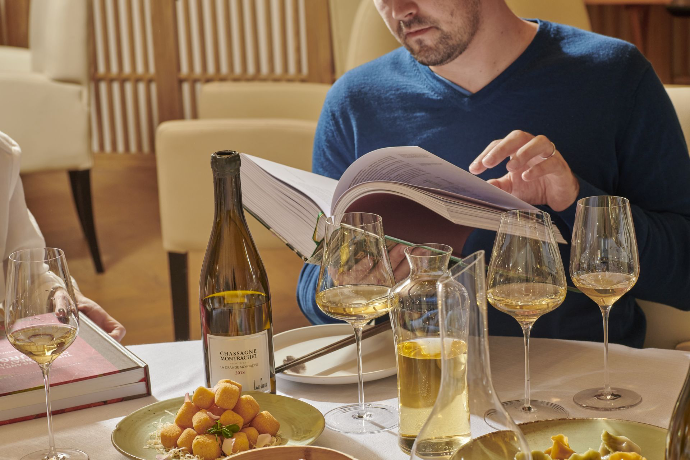
This is where the grape often becomes broader, richer, and more textural, and where the most famous villages — Meursault, Puligny-Montrachet, and Chassagne-Montrachet — have come to define the upper limits of still white Burgundy. If Chablis is built around tension, the Côte de Beaune is built around amplitude. The wines tend to show riper fruit, more width across the palate, and a more visible role for élevage. Oak is often part of the conversation. Malolactic fermentation is very common, though not universal. Lees work is important. All of this contributes to a style of Chardonnay that can move toward hazelnut, butter, cream, smoke, toast, and spice without losing its essential seriousness.
This is also the part of the Chardonnay story that created both its admirers and its critics. Because in the right hands, the richer style becomes one of the most complete expressions in white wine: generous but not heavy, layered but not diffuse, powerful yet still composed. In the wrong hands, it can become over-shaped, with oak sitting above the fruit rather than inside it. The greatest Côte de Beaune wines avoid that trap because their weight is never only technical. It begins in the vineyard. It begins in the material itself.
That is why these wines can stand beside serious food in a way few white wines can. Not simply fish, but turbot, lobster, roast poultry, mushrooms, cream sauces, dishes with depth and density. Great Chardonnay from the Côte de Beaune does not merely accompany those plates. It meets them on equal terms.
And that, finally, is what makes Chardonnay so singular.
It can be part of a Champagne blend and still define the wine. It can become Blanc de Blancs and show an almost architectural purity. It can turn into Chablis and speak through acidity, stone, and line. It can travel south into the Côte de Beaune and become deep, enveloping, and quietly grand. It can satisfy drinkers looking for freshness and those looking for richness, often without changing grape. The style changes. The voice changes. The texture changes. But the variety remains.
No other white grape moves so convincingly across that entire spectrum.
Final Thought
The greatness of Chardonnay lies in the fact that it does not insist on one identity. It responds. To chalk, to limestone, to climate, to exposure, to élevage, to time. In some places it becomes sharper, in others broader. In some places it speaks in citrus and salt, in others in butter and smoke. But at its best, Chardonnay always does the same thing: it holds flavour and structure in balance. And that is why it has so many faces without ever becoming anonymous.